
Target Technology: Digital Identity & Asset Systems
Target Audience: Bitcoin Developers
Blockchain Commons Bitcoin Stack is a huge collection of technologies created over the course of a decade with the intent of supporting the Gordian principles: we want to encourage the creation of digital identity and asset systems where: users are independent and able to make their own decisions; content is private, to protect users against coercion; secrets are resilient, so that they’re not lost; and protocols are open, allowing everyone to interoperate within a shared ecosystem. Each technology in the Gordian Stack is intended to meet one or more of these goals.
This is not a complete listing of Blockchain Commons specifications (for that dig down from the technologies page), but it is extensive and covers the major building blocks in the stack.
Data Formats
Data formats are the foundational blocks that we use to build up to our principle-focused technologies.
 ByteWords - A method
for encoding a binary byte as a four-letter word, useful for storing
secrets, but also a building block of URs.
 dCBOR - A deterministic
version of the CBOR binary data format, allowing for the deterministic
hashed data elision used in Envelope.
 Gordian Envelope - A
"smart" data storage format that incorporates compression, encryption, and
also deterministic hashed data elision. Built to support selective
disclosure, and a building block for XIDs.
 Uniform Resources (URs) -
A method for encoding binary strings as text strings, using Bytewords.
A resilient data storage method and a building block of Animated QRs.
Data Resilience
The Gordian Principles generally call for data to be self-sovereign: held by the user. But for that to work, the data must be resilient as well.
 Collaborative Seed Recovery
(CSR) - Using SSKR, CSR allows a user to shard a secret, store
it on remote servers, and later recover it from some of those shares.
 Sharded Secret Key
Reconstruction (SSKR) - An expansion of Shamir's Secret Sharing
that allows the sharding of a secret and then its recovery from a
threshold of individuals or groups.
Digital Signatures
Cryptographic signatures can prove identity and provenance. They link to our digital identity systems and to data stoage systems like Gordian Envelope.
 Open Integrity -
A system of signatures that proves the integrity and provenance of a Git repo.
 Provenance Marks
Hash chains that link digital objects so that ordering can be proven.
Blockchain Commons also supports third-party Schnorr signature technologies such as FROST and MuSig2.
Secure Communication
Secure communication is need to ensure interoperability and to provide additional resilience and privacy for users.
 Animated QRs -
Animated QRs allow for the transmission of large amounts of information across airgaps in a self-describing way, using URs.
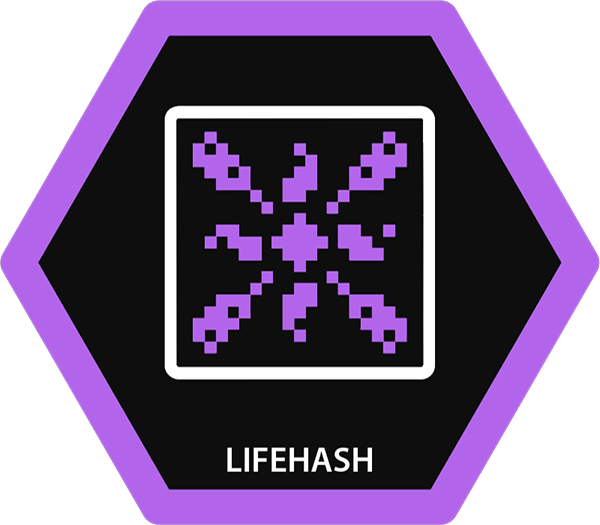 LifeHash -
Secure communication depends on knowing what you're transmitting. LifeHash enhances the recognition of big digital values.
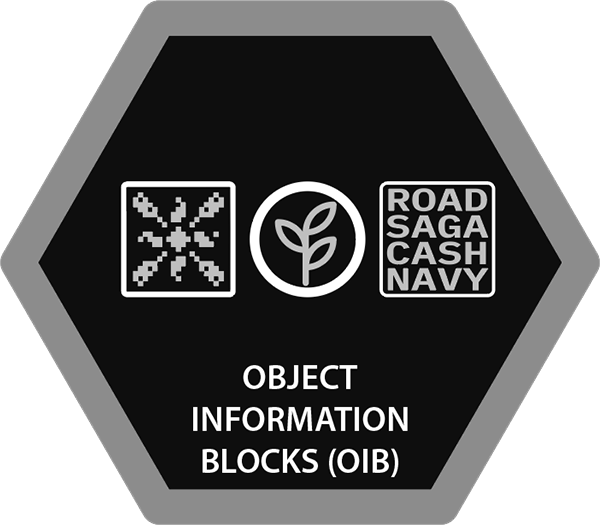 Object Identity Block (OIB) -
Lifehashes are just one element in an OIB, whose overall purpose is to aid in data recognition.
Digital Identity
Digital identity is one of our capstones: much of our previous technology has been built to support it.
 Cryptographic Cliques
- A model for identity that uses signatures to define
relationships beetween entities.
 Cloudflare Passkey -
A passkey-only identity system built on Cloudflare Workers and Durable Objects.
 Gordian Clubs - A
method of self-sovereign communication intended to allow the
transmission of information by members of a club.
 XIDs - Our
best-developed system for self-sovereign identity, built on top of
Gordian Envelope as an autonomous cryptographic object that the user
controls.