This is a hands-on command-line introduction to Gordian Envelope in the style of Blockchain Commons’ from the Command Line courses. It makes use of the Rust-based envelope-cli.
Also see “Learning Envelope Seeds from the Command Line”.
What is a Gordian Envelope?
A Gordian Envelope is a data structure that combines:
- Structured semantic information (like who did what)
- Cryptographic verification (like digital signatures)
- Selective disclosure capabilities (through elision)
Think of an Envelope as a container that can hold information in a structured way, be securely sealed to verify its source, and have parts selectively revealed while keeping other parts private.
The Subject-Assertion-Object Model
Gordian Envelopes use a structure similar to sentences in natural language:
<SUBJECT> [
<PREDICATE>: <OBJECT>
...
]
For example:
"BRadvoc8" [
"name": "BRadvoc8"
"domain": "Distributed Systems & Security"
"experienceLevel": "8 years professional practice"
]
In this structure:
- Subject: The main entity the envelope is about (“BRadvoc8”)
- Predicate: A property or relationship (“domain”, “experienceLevel”)
- Object: The value of that property (“Distributed Systems & Security”, “8 years professional practice”)
This structure creates clear, semantic relationships that are both human-readable and machine-processable.
Types of Assertions You Can Make
You can make various types of assertions within an Envelope:
- String assertions: Simple text values
"name": "BRadvoc8"
- Structured data assertions: Complex data types
"location": {
"latitude": 47.6062
"longitude": -122.3321
}
- Nested envelope assertions: Envelopes within envelopes
"project": ProjectEnvelope [...]
- Cryptographic assertions: Digests, signatures, etc.
"documentHash": SHA256(a7f3ec...)
Anything can be held in an Envelope, from small declarations to large sets of data.
Signing and Verification
Envelopes can be cryptographically signed to verify:
- Who created or endorsed an Envelope
- That the content hasn’t been altered since signing
The signing process consists of two steps:
- A private key is used to generate a digital signature of the Envelope.
- The signature is attached to the Envelope.
In the envelope-cli tool, the process looks like this:
PRIVATE_KEYS=$(envelope generate prvkeys)
PUBLIC_KEYS=$(envelope generate pubkeys "$PRIVATE_KEYS")
SIGNED_PROPOSAL=$(envelope sign -s "$PRIVATE_KEYS" "$WRAPPED_PROPOSAL")
The public key of the keypair can then be used to verify the signature. This confirms the Envelope was signed by the corresponding private key.
envelope verify -v "$PUBLIC_KEYS" "$SIGNED_PROPOSAL"
This creates non-repudiation: the signer cannot deny creating the signature if it verifies with their public key.
Wrapping & Signing
Any assertion in an Envelope always applies to its subject: the subject predicates the object. This applies to signatures too: a signature signs the subject. It does not sign the other assertions on that subject.
As a result, the following is usually not what’s intended:
"BRadvoc8" [
"name": "BRadvoc8"
"domain": "Distributed Systems & Security"
"experienceLevel": "8 years professional practice"
SIGNATURE
]
This SIGNATURE only applies to the subject, BRadvoc8, not to the
assertions about their experience.
The solution is to “wrap” the envelope before signing it, creating a
new Envelope with the original Envelope as its subject. This way, the
signature applies to the entire original Envelope, including all its
assertions. (That’s why a $WRAPPED_PROPOSAL was used in the example above.)
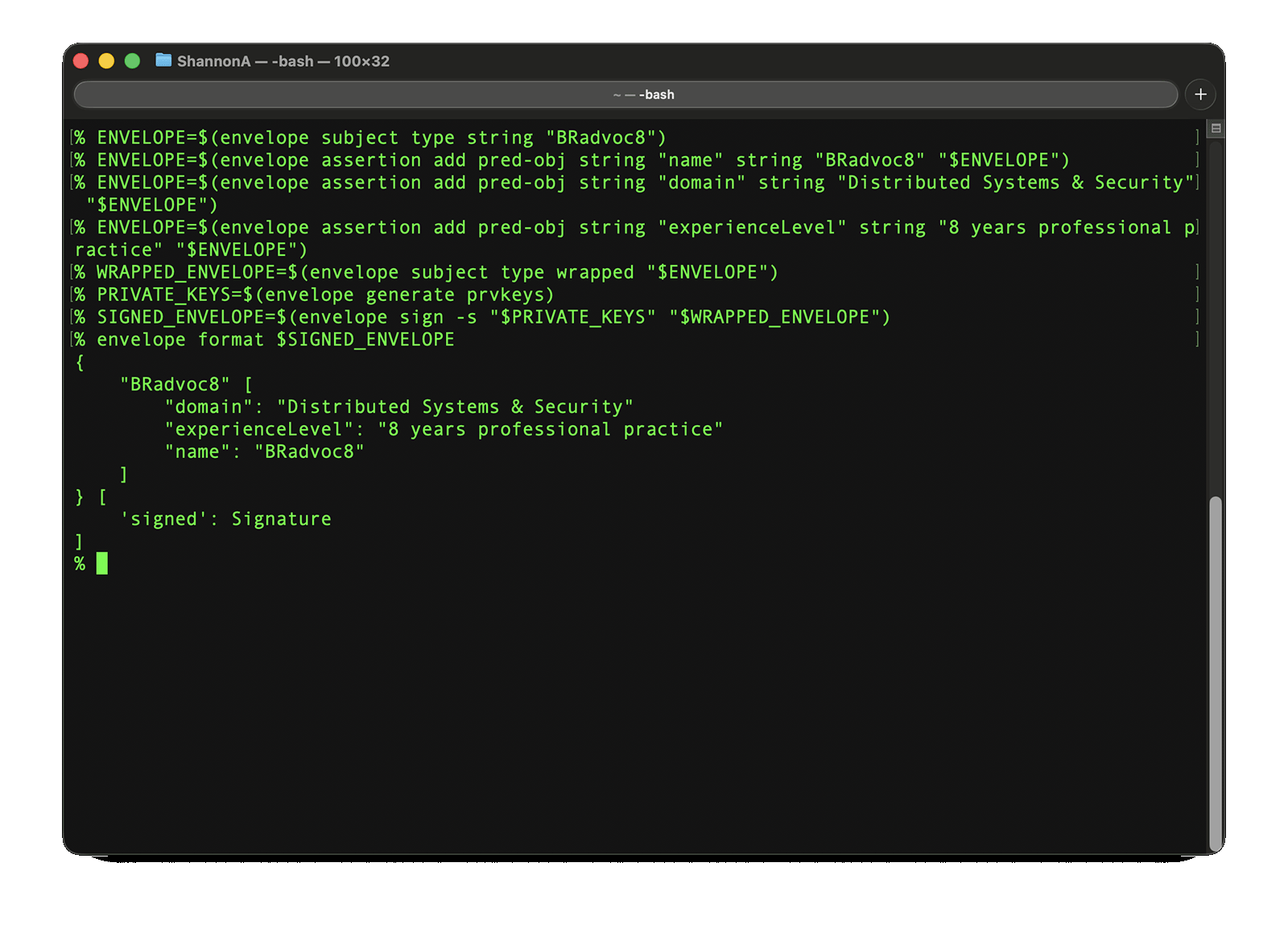
First, create your envelope with all assertions
ENVELOPE=$(envelope subject type string "BRadvoc8")
ENVELOPE=$(envelope assertion add pred-obj string "name" string "BRadvoc8" "$ENVELOPE")
ENVELOPE=$(envelope assertion add pred-obj string "domain" string "Distributed Systems & Security" "$ENVELOPE")
ENVELOPE=$(envelope assertion add pred-obj string "experienceLevel" string "8 years professional practice" "$ENVELOPE")
Then, wrap the envelope before signing
WRAPPED_ENVELOPE=$(envelope subject type wrapped "$ENVELOPE")
Finally, sign the wrapped envelope
SIGNED_ENVELOPE=$(envelope sign -s "$PRIVATE_KEYS" "$WRAPPED_ENVELOPE")
This creates a structure where the signature applies to the entire original Envelope:
envelope format $SIGNED_ENVELOPE
| WRAPPED {
| "BRadvoc8" [
| "name": "BRadvoc8"
| "domain": "Distributed Systems & Security"
| "experienceLevel": "8 years professional practice"
| ]
| } [
| SIGNATURE
| ]
This ensures the signature verifies the integrity of all assertions in the original envelope, not just its subject.
Enabling Both Verification and Privacy
One of the most powerful features of Gordian Envelopes is the ability to maintain cryptographic verification even when parts of the data are hidden through elision.
For example, if you have a properly wrapped and signed envelope:
WRAPPED {
"BRadvoc8" [
"name": "BRadvoc8"
"domain": "Distributed Systems & Security"
"experienceLevel": "8 years professional practice"
]
} [
SIGNATURE
]
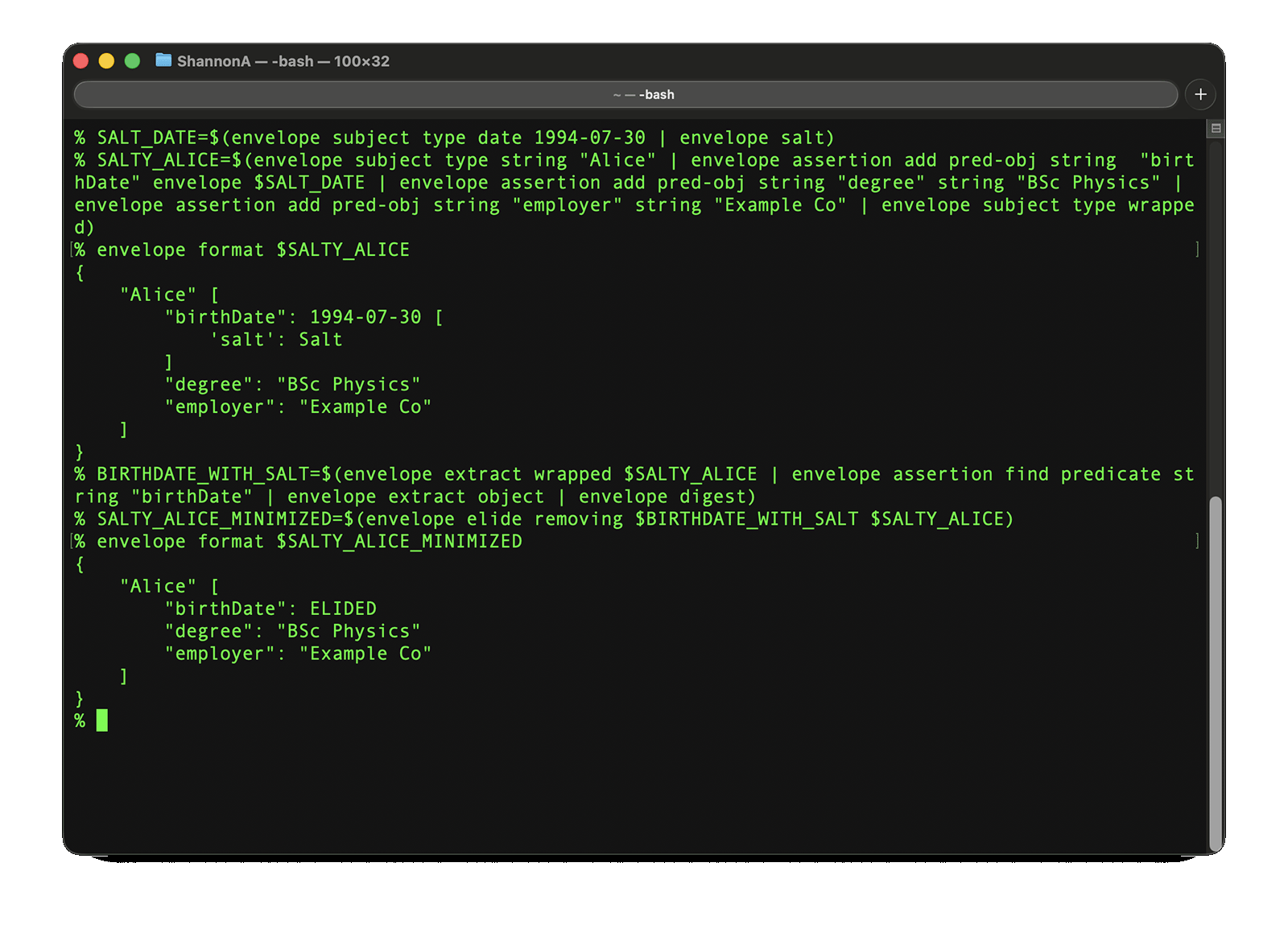
You can elide (remove) the experienceLevel assertion while maintaining the signature’s validity:
WRAPPED {
"BRadvoc8" [
"name": "BRadvoc8"
"domain": "Distributed Systems & Security"
ELIDED
]
} [
SIGNATURE
]
The signature remains valid because all of the elements in an Envelope are hashed, then the hash of the wrapped Envelope (which is the sum of the hashes below it) is what’s actually signed. The hashes remain, even when the content that produced them is elided.
This allows for:
- Privacy-preserving information sharing
- Minimizing data exposure while maintaining verification
- Revealing different information to different audiences
- Progressive disclosure as trust develops
Using Envelopes with XIDs
XIDs use Gordian Envelopes as their container format. This supports structured, semantic representation of identity information and allows selective disclosure of that information to protect privacy. It can be used for use cases such as:
- Identity Information: Structuring claims about a person or entity
- Signed Documents: Creating verifiable records and attestations
- Evidence Commitments: Committing to evidence without revealing it prematurely
- Trust Assertions: Making claims that others can verify and build upon
The Learning XIDs from the Command Line course offers extensive details on how XIDs and Envelope interrelate.
Check Your Understanding
- What is the basic structure of a Gordian Envelope?
- How does the subject-assertion-object model represent information?
- What happens when an Envelope is signed, and how is the signature verified?
- How can an Envelope be elided while maintaining signature validity?
- Why is the combination of verification and privacy so powerful?
Next Steps
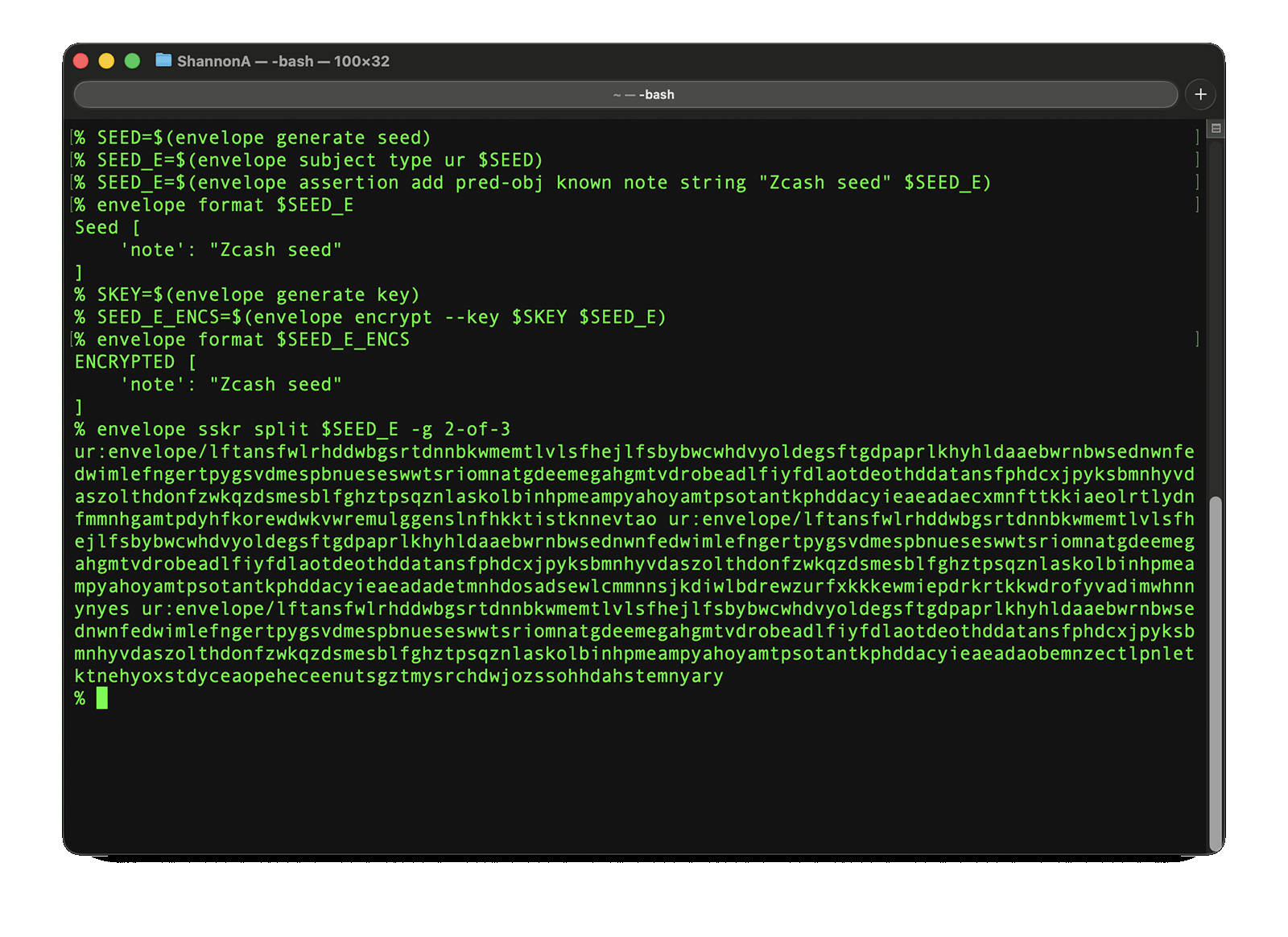
You may also want to read “Learning Envelope Seeds from the Command Line” for an in-depth example of using Envelope to store a specific sort of cryptographic object.
Download the Software
- Envelope CLI:
cargo install bc-envelope-cli