
Traditional digital systems often rely on centralized authorities and binary trust decisions. Progressive Trust instead restores human choice and agency by enabling nuanced, contextual trust evaluations that can be adjusted based on new evidence and interactions. Its goal is to model how trust works in the real-world, acknowledging that trust develops gradually, evolves over time, and exists in shades of gray rather than black and white.
Real-world vs Online Trust
Traditionally, people came together in a medium where their personal data was innately minimized and gradually got to knew each other until they’d developed sufficient trust to engage in some interaction for mutual benefit, which could be anything from hiring someone as a contractor to marrying them. As social psychologist James W. Pennebaker said, “Conversations are like dances.” It’s a mature process that evolved over thousands of years.
Perhaps the internet was like that in its early days, when you met
someone on a MUD or engaged in a talk and learned more about them
over time. But when the internet became commercialized in the ’90s,
powerful institutions brought new models for interactivity. They
gained economic benefit from limiting what you could see. This
allowed them to simplify usability and to create their own controlled
communities, all of which increased their commercial viability, so
limit they did. That’s the internet that exists today. Centralized
entities offer you restricted views of your fellows and provide binary
choices on silver platters: trust or not. There are no shades of gray,
there is no progression. Decisions are made by them, not us.
Web browsers offer an example. They tell us who to trust on the internet, but they do so without nuance. They tell us sites that have been able to acquire certificates, legimately or illegimately. They don’t tell us sites with a record of stability, they don’t tell us sites with a reputation for truth, and they definitely don’t tell us who to trust on those sites. This is just one of the places that progressive trust can benefit the internet, for trust isn’t black and white: it exists in a world of gray.
Fortunately, the wheel is turning again. The modern internet offers distributed and decentralized systems that put choice back into the hands of individuals, allowing them to make decisions without the coercion, censorship, and unbalanced power of centralized systems. This allows the creation of systems where a user isn’t served up binary choices for trust based on limited information. Technologies such as data minimization and selective disclosure improve the situation even more. They can further protect our human dignity and choice by letting us choose to slowly (progressively) reveal our own information over time. We just need to normalize these technologies and apply them to human interactions that have been warped by the 21st century corpocratic control of the internet. We need to apply them fully in order to fully trust.
Creating a Life Cycle
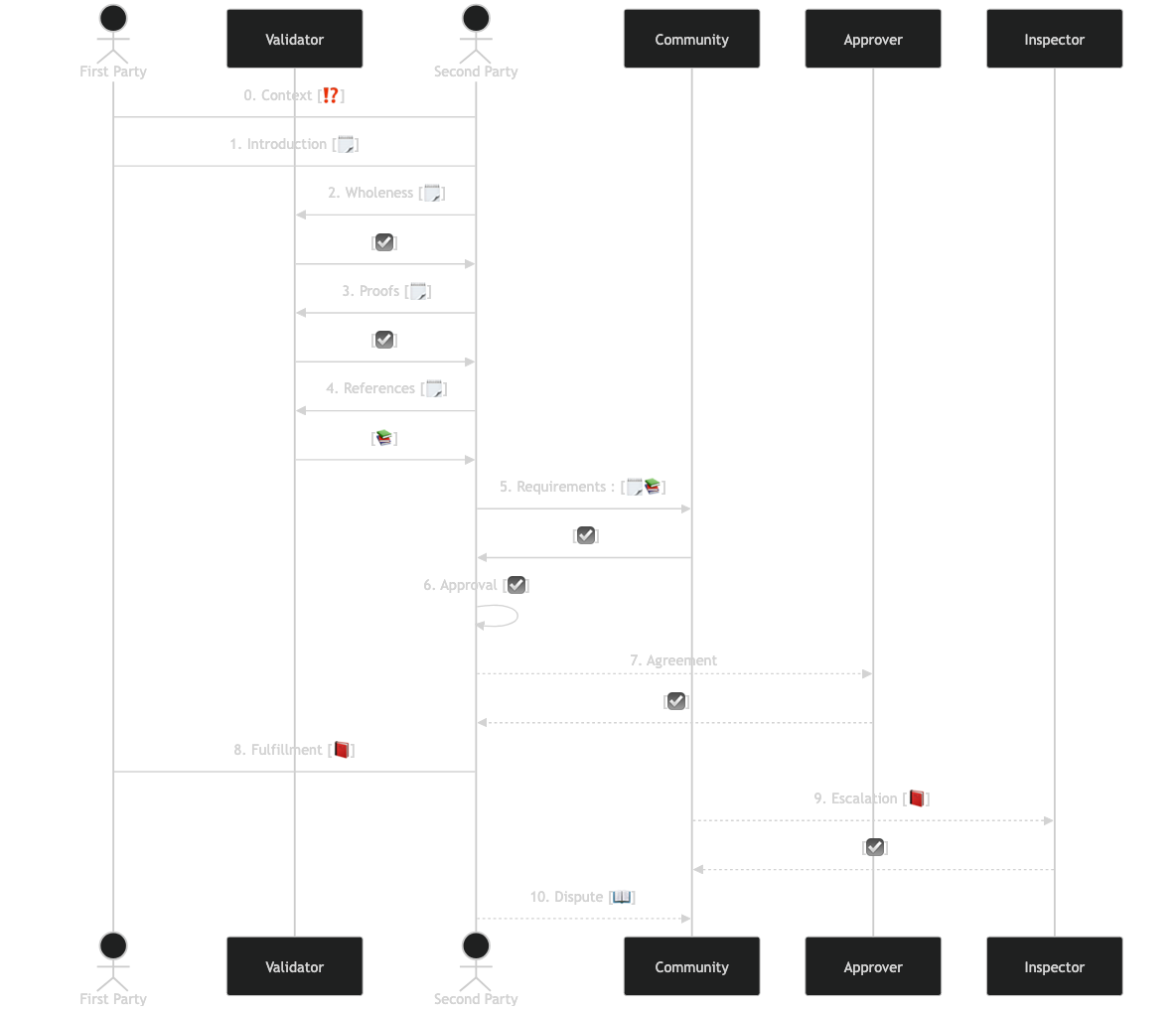
One way to understand Progressive Trust is as a Life Cycle. Two parties come into contact with each other, introduce themselves, and then slowly learn about each other through what they say (self-attestations) and what the community says (peer endorsements).
It they ultimately agree to interact in some meaningful way, they come to an agreement and it’s fulfilled, which could either lead to feedback or else escalation and dispute.
Creating Trust Networks
Another way to understand Progressive Trust is as a network. That’s because progressive trust doesn’t exist in isolation. It forms a web of trust relationships across different contexts:
Person A -- trusts --> Person B   (in context X with trust level 0.8)
                    -- trusts --> Person C   (in context Y with trust level 0.6)

Person B -- trusts --> Person D   (in context X with trust level 0.7)

Person C -- trusts --> Person D   (in context Y with trust level 0.9)
This means Person A might derive indirect trust of Person D through different paths with different trust levels in different contexts.
Building Assertions
Any Progressive Trust is ultimately based upon having a bucket of assertions and revealing them over time. These might be self-attestations, peer endorsements, or other sorts of claims. They might be very structured, like attestations revealed in XIDs (including fair witness assertions, observation context, and endorsements) or they might be freeform, like things revealed in conversation.
Implementing Selective Disclosure for Progressive Trust
Any structured set of claims can support elision cryptography to enable progressive trust: individual datums are elided, then revealed as trust increases.
However, this requires careful design of the structure. Information that is to be revealed at different stages of progressive trust must be placed in atomic data holders that can be individually elided, and they should be grouped into topics that could be elided as a whole. For example, it’s not very helpful to include a whole home address in a single datum when the user might only want to reveal a country, state, or zip code. This data should be divided up, but it should continue to be categorized as a group so that either an individual datum or the group could be redacted or revealed.
Selective disclosure is most often required when some of the progressive trust information is private, but the overall information packet, which might include agreement sign-offs or other signatures, must be disclosed.
Examples of selective disclosure might include:
- Elision of initial assertions about an identity that might break privacy.
- Elision of collected references that might be prejudicial.
- Elision of details of approval or agreement that might be prejudicial to the counterparty.
In all of these cases, the data can be elided while maintaining signatures, such as those offered for approval.
Progressive Trust in XIDs
Gordian Envelope and XIDs offer tools for implementing progressive trust in digital systems. XIDs provide stable identifiers for entities across trust networks while Gordian Envelope enables context-specific trust assertions and selective disclosure.
To implement progressive trust using XIDs:
- Create XIDs for all entities in your trust network.
- Define trust contexts as specific domains of interaction (e.g., “code review,” “document attestation”).
- Use the life cycle phases to track progression of trust in each context.
- Document trust assertions using envelopes with appropriate attestations and endorsements.
- Implement selective disclosure to reveal appropriate information based on trust level.
- Build trust scores that adapt based on successful progression through the life cycle phases.
- Track trust history to enable evolution of trust over time.
For more, see Learning Progressive Trust from the Command Line.
Progressive Trust Links
Progressive Trust:
- Progressive Trust Musings (Blockchain Commons blog)
- Progressive Trust Life Cycle
- Learning Progressive Trust from the Command Line
Refererence Apps: